
Abstract: AI agent security is the practice of discovering, governing, and controlling AI agents that can access systems, use tools, trigger workflows, interact with SaaS apps, and act through user-delegated sessions, service accounts, OAuth grants, API keys, or other non-human identities.
This guide covers:
- How AI agent security works
- Why agents create new identity and access risks
- Which controls help security teams govern agent sprawl before it becomes exposure
AI agents are not just another AI feature to monitor for unsafe outputs. They are becoming operational actors inside business workflows.
A sales agent might update CRM records, or an HR agent might interact with onboarding tools or employee data. In each case, the security question is what the agent can access, which identity it uses, what action it takes, and whether that action matches its intended purpose.
Gartner predicts that over 40% of agentic AI projects will be canceled by the end of 2027 due to escalating costs, unclear business value, or inadequate risk controls. If you are responsible for AI adoption, security, identity, or governance, the control problem is already here: agents are moving into production faster than most organizations can govern them.
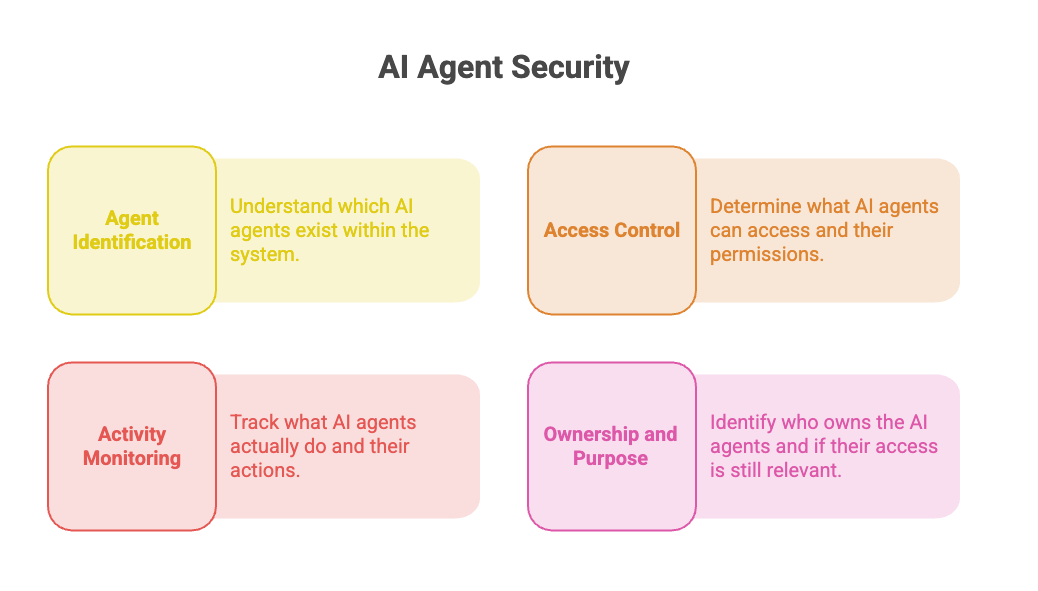
For security teams, the issue is whether your organization can see which agents exist, what they can access, which identities they use, and whether their actions match their approved purpose.
What is AI agent security?
AI agent security is the discipline of managing the risks created when AI agents operate across enterprise systems. Unlike a standard AI assistant that mainly generates text, summarizes information, or responds to a user, an AI agent can take action. It may call APIs, use tools, trigger workflows, update records, or interact with SaaS applications through human or non-human identities.
For security teams, that changes the control question. It is not enough to know what an agent is intended to do. Teams also need to know:
- Which agents exist
- Who owns them
- Which identities they rely on
- What permissions they have
- Which systems they connect to
- What actions they actually take
AI agent security connects those details so security teams can review agent risk in context. In practice, this includes inventory, ownership, identity mapping, access review, integration mapping, action tracing, risk prioritization, and remediation workflows.
The core issue is that intent is not execution. A sales agent may be approved to summarize customer calls and create follow-up tasks, but its real access may expand through delegated credentials, broad OAuth scopes, new SaaS integrations, or workflow changes. If security teams only review the agent’s stated purpose, you may miss what it can actually access or execute.
Ai Agent Security
Why AI Agents Create a New Security Problem
Traditional security models are usually built around human users and managed non-human identities. AI agents complicate that model by combining business intent, delegated access, automation, and action.
A service account or workload identity typically authenticates between applications for a defined technical purpose. An AI agent can cross those boundaries. It may be created on an agent platform, triggered by a human user, and allowed to execute workflows using its own credentials or delegated access.
That makes agents security-relevant business actors. Traditional role-based access control becomes harder to apply because an agent’s access is not always cleanly tied to a single employee’s role.
A shared agent may operate through broad service credentials while being triggered by users with different privilege levels, making agent access governance a distinct control requirement.
A low-privileged user may not have access to update a sensitive business workflow directly. But if that user can trigger an agent with broader execution rights, the downstream system may see only the agent’s credentials, not the user’s true authorization level. The result is a delegated-access gap that can bypass the assumptions underlying conventional access governance.
How AI Agent Security Differs From Model-Layer AI Security
Model-layer tools can help secure prompts and model behavior, but they do not give you full control over the AI agent infrastructure that connects identities, credentials, tools, SaaS apps, and workflows.
| Control area | Model-layer AI security | AI agent security |
|---|---|---|
| Primary concern | Model misuse, unsafe outputs, prompt injection, and data leakage | Agent identity, access, actions, ownership, and business risk |
| Main asset | Model, prompt, response, training data, or retrieval data | Agent, linked identity, credential path, integrations, and workflows |
| Access model | Controls what the model can receive or return | Controls what the agent can access and execute |
| Risk question | Could the model produce or expose something unsafe? | What can this agent do, under which identity, and does that match its purpose? |
| Traceability | Prompt and response logs | Originating user, agent, identity used, action taken, and system affected |
| Governance | AI policies, usage rules, and model approval | Live inventory, access review, action tracing, risk prioritization, and remediation |
| Drift | Model behavior or output quality changes | Permission drift, integration drift, behavior drift, and purpose mismatch |
| Example | A chatbot returns sensitive content in a response | A finance agent uses broad credentials to access reporting data or trigger a workflow it was not meant to execute |
Key AI Agent Security Risks to Know About
Unknown Agents and Agent Sprawl
Over time, security teams may lose track of which agents exist, who owns them, and which systems they touch. Unknown agents are difficult to govern because they may not appear in normal review cycles. They may also fall outside non-human identity reviews or lack a clear owner. Yet they may still have real access but remain outside standard identity, access, and governance processes, leading to agent sprawl.
Excessive Access and Permission Drift
Permission drift often starts with a narrow use case, such as a finance agent designed to pull reports. The problem is that access rarely stays static as new integrations get added and APIs expose more than the workflow requires.
Permission drift is the gap between what the agent was meant to access and what it can actually access. It is especially hard to detect when security teams can see the local agent configuration but not the full identity and access picture across connected systems.
Agent-Linked Identity Risk
AI agents do not operate in isolation. They rely on identities, accounts, tokens, API keys, delegated user access, service accounts, or other non-human identities, which makes monitoring NHI activity an important part of understanding agent risk.
Without mapping agents to their linked identities, teams may see an action in a downstream system but miss the agent and identity chain that caused it. As a result, the credential path behind each agent creates a critical control point.
Low-Privileged Users Triggering High-Privileged Agents
Delegated access creates a specific risk. A low-privileged employee may be able to trigger an agent that acts through broader credentials than the user would be granted directly.
This risk breaks simple assumptions about user-based access control. The initiating user and the executing identity are not always the same, and downstream systems may not understand the difference.
Action Attribution Gaps
When an agent takes action, auditability depends on attribution. Security teams need to understand who initiated the request, which agent executed the workflow, which identity was used, what action occurred, and which system or data was affected.
Without that chain, access reviews become less reliable, and governance teams struggle to prove whether agents are operating within approved boundaries. In the event of a security incident, teams may know something happened but lack the context to explain how it occurred and who or what caused it.
Sensitive Data and Integration Exposure
AI agents become more useful as they connect to more systems, but each integration also expands exposure. The broader risk is that an agent can access, move, update, or trigger workflows involving sensitive data across connected systems, not just that sensitive data could appear in a model output.
Behavior Drift
An agent’s behavior can drift as prompts, workflows, tools, permissions, integrations, and business use cases change. A support agent may begin with access to public documentation, then later gain access to internal troubleshooting materials. Behavior drift matters because an agent may still appear useful while moving beyond its original purpose.
 6 AI Agent Security Best Practices for Identity, Access, and Action Control
These AI agent security best practices start with the same operational question: can the security team see the agent, understand its access, trace its actions, and decide whether the risk needs review?
1. Build a Live Inventory of Every AI Agent
Security teams cannot govern agents they cannot see. The first step is to build a live inventory of AI agents across cloud applications, SaaS platforms, agent factories, identity providers, and business workflows.
This inventory should capture where the agent was created, who owns it, what business process it supports, which systems it connects to, which identity or credential it relies on, what permissions it has, and whether it is active, dormant, shared, or unmanaged.
A sales agent may be approved to summarize calls and update CRM records, while also connecting to Salesforce, call recordings, Slack, Jira, and customer notes. Without a live inventory, security teams may not know the agent exists, which data it can access, or whether anyone is reviewing its access.
2. Map Each Agent to Its Linked Identities, Credentials, and Integrations
Every AI agent depends on identity. It may act through a user-delegated session, an OAuth grant, a service account, an API key, a machine-to-machine token, or an integration account with its own permission model. Security teams need to map that credential path before they can assess the agent’s real access.
This is where AI agents differ from simple AI tools. A chatbot may answer a user. An agent may execute a workflow using an identity with broader access than the user who triggered it. If the security team only reviews the user’s role, it may miss the credential the agent actually used downstream.
A finance reporting agent may be intended to collect read-only billing data, but actually operate through a shared service account with access to invoice records, payment workflow metadata, or customer billing history. That gap is only visible when the agent is mapped to its linked identity, token scopes, connected apps, and API permissions.
3. Compare Intended Access With Actual Access
AI agent security depends on comparing what an agent was meant to do with what it can actually access. An HR onboarding agent may be approved to create onboarding tasks, update directory fields, and send new-hire reminders. That does not mean it should have access to compensation data, performance records, sensitive HR cases, or broad employee history.
This comparison should account for more than direct permissions. Security teams need to evaluate inherited SaaS access, OAuth scopes, API permissions, workflow triggers, third-party integrations, and data sources exposed through connected tools. An agent may appear tightly scoped in one platform while retaining broader reach through another.
This is where agent security becomes more than inventory. Security teams need to compare intended access, actual access, and observed actions to identify agents that are over-permissioned, misaligned, or drifting from purpose.
At this point, teams need a control layer for AI agents: a way to connect the agent, owner, linked identity, permissions, observed actions, and business context in one place.
4. Enforce Least Privilege Across Tools, APIs, SaaS Apps, and Workflows
Least privilege for AI agents needs to be enforced across the identity, tool, API, SaaS, and workflow layers. A support agent designed to summarize tickets may need access to ticket text, but should not inherit access to internal engineering notes, admin settings, or unrelated customer records.
In practice, security teams should review SaaS roles, API scopes, OAuth grants, plugin permissions, Model Context Protocol (MCP) server access, memory permissions, and workflow execution rights together.
Platform defaults often favor functionality over constraint, so broad scopes may increase the blast radius if an agent is misused, misconfigured, or prompted into an unintended workflow.
5. Control Delegated Access and User-to-Agent Privilege Gaps
Delegated access creates a user-to-agent privilege gap when the person who triggers an agent has fewer privileges than the identity the agent uses to execute the action. A low-privileged employee may be blocked from a sensitive system directly, but still be able to trigger an agent that uses a high-privilege service account.
Security teams should constrain sensitive actions by the initiating user’s identity, the agent’s approved purpose, and the risk of the downstream action. For higher-impact workflows, that may mean step-up approval, policy checks before execution, just-in-time access, or human review before the agent can modify records, approve transactions, provision access, or delete data.
6. Trace Agent Actions Back to the Originating User, Identity, and Workflow
Action traceability turns agent security from policy into evidence. When an agent takes action, security teams need to reconstruct the full chain: the originating user or identity, the agent, the credential used, the workflow invoked, the system touched, and the data or object affected.
Without this chain, a security investigation may show the end result but not the agent path that led there. If a shared sales agent updates a CRM opportunity, the business needs to know whether the change was initiated by an account executive, an automated workflow, or another identity. Action tracing should connect logs across the agent platform, identity provider, SaaS application, API layer, and workflow system wherever possible.
How to Bring AI Agent Security Into Existing Workflows
These controls only matter if they become part of day-to-day security work. Policies are necessary, but they are not enough. A policy may require agents to have owners and audit trails. Unless security teams can discover agents, map identities, compare access, trace actions, and push findings into existing review workflows, governance remains static.
Once you have reviewed AI agents alongside the identities, applications, and permissions they depend on, you can bring agent context into security investigations. If an unusual action occurs in a SaaS app, cloud workflow, or business system, investigators should be able to determine whether an agent executed it, which identity it used, and which user or workflow initiated it.
AI adoption governance also needs agent context. Responsible AI adoption requires operational control over the agent layer. Unknown agents, excessive access, unclear ownership, risky integrations, and attribution gaps need to be visible enough to review and act on. The goal is to make agent risk part of the security and identity workflows your organization already uses.

Secure AI Agents Before Access Becomes Exposure
AI agents can help teams move faster, but only if security teams can keep the agent layer accountable. Model-layer security and traditional access tools each solve part of the problem. Security teams also need to know which agents exist, what they can access, which identities they use, and whether their actions still match their intended purpose.
Wing Security is the control layer for AI agents. It helps security teams connect agent discovery, access context, action tracing, and risk prioritization so they can govern agent sprawl without slowing responsible AI adoption.
Wing helps security teams find the AI agents already running across cloud apps, agent platforms, identity systems, and business workflows. It turns that activity into a live inventory that shows who owns each agent, what it can access, which systems it connects to, what it is doing, and where risk is starting to build.
That gives teams a clearer way to compare what an agent was meant to do with what it can actually access. You can trace agent activity back to the originating user or identity, spot agents that are over-permissioned or drifting from purpose, and bring those findings into the security and access-review workflows they already use.
Request a demo to discover unknown agents, verify access, trace actions, and govern agent sprawl before it becomes exposure.