

Tools for monitoring non-human identity activity help security teams discover, inventory, govern, and investigate the activity of machine identities, service accounts, OAuth apps, API keys, workload identities, integrations, and AI agents.
Top Monitoring Non-Human Identity Activity Tools Include:
- Wing Security
- Cyberhaven
- MCPTotal / Autonomous Security
- Operant AI Endpoint Protector
- Akeyless
- GitGuardian
- Entro Security
- Astrix Security
- Clutch Security
- Token Security
- Aembit
- Silverfort
- Apono
- ConductorOne / C1
- Valence Security
The agent is not the account. That is the problem security teams now have to solve. A service account or workload identity can tell you that something has access. However, it doesn’t always tell you what is acting through that access, who initiated the action, whether the behavior matches the intended purpose, or which business risk matters first.
The urgency to answer these questions stems from the fact that AI agent adoption is moving faster than governance. Deloitte reported that only 21% of surveyed organizations said they have a mature governance model for agentic AI, while 74% expect to use AI agents at least moderately by 2027.
For enterprises adopting AI agents, the monitoring problem is no longer just credential activity. It is agent identity, intended access, actual access, action traceability, and business risk.
This guide compares tools for monitoring non-human identity activity across organizational AI agents, local agents, secrets, API keys, service accounts, workload identities, SaaS integrations, and cloud access. You’ll get top picks and a practical way to choose the right platform.
What are tools for monitoring non-human identity activity?
Tools for monitoring non-human identity activity help security teams understand which machine identities, service accounts, OAuth apps, API keys, workload identities, integrations, and AI agents exist.
Plus, these tools help identify what NHIs can access, how they are used, who owns them, and whether their activities pose risk, especially as agentic AI introduces new actors into business workflows.
These tools go beyond SIEM-style log monitoring. Operational monitoring includes inventory, ownership, access paths, credential use, OAuth grants, permission drift, agent-triggered actions, originating identity, risky behavior, and remediation workflows.
NHI monitoring tools are mainly for security, DevSecOps, and governance teams that need to reduce exposure from machine-to-machine access as AI adoption expands.
Top Picks at a Glance
- Recommended for organizational AI agents: Wing Security
- Recommended for local agents: Operant AI Endpoint Protector
- Recommended for API keys / secrets: GitGuardian
- Recommended for service accounts: Silverfort
Comparison Table: Best Tools for Monitoring Non-Human Identity Activity
| Tool | Recommended for | NHI / agent type covered | Monitored activity | Access intelligence | Agent-specific fit | Ownership & attribution | Key limitation | Public pricing |
|---|---|---|---|---|---|---|---|---|
| Wing Security | Organizational AI agents | AI agents, agent-linked identities, SaaS integrations, cloud app access | Agent access, cross-app actions, permission drift, risky behavior | Strong | Strong | Strong | Best suited for agent-layer governance, not standalone secrets management | Not publicly listed |
| Cyberhaven | AI-related data exposure | Local AI use, employee workflows, AI-assisted data movement | Sensitive data movement, data exfiltration, insider-risk signals | Medium | Medium | Medium | Data-security-led rather than NHI-governance-led | Not publicly listed |
| MCPTotal / Autonomous Security | Local MCP workflows | MCP servers, local agents, plugins, skills | MCP traffic, endpoint agent execution, unsafe tool use | Medium | Strong | Medium | Focused on local/MCP activity, not enterprise-wide agent governance | Not publicly listed |
| Operant AI Endpoint Protector | Endpoint AI agent activity | AI IDEs, coding agents, MCP clients, plugins, tools | Prompt injection, secret leakage, rogue tool calls, file and shell access | Medium | Strong | Medium | Endpoint-first; limited coverage for SaaS and IdP-level governance | Not publicly listed |
| Akeyless | Static machine credential replacement | Workloads, service identities, API credentials, secrets | Workload authentication, credential use, secretless access | Strong | Medium | Medium | Stronger for workload authentication than agent behavior | Free trial available; pricing not fully public |
| GitGuardian | Exposed secrets in developer workflows | API keys, tokens, hardcoded secrets, developer credentials | Secret exposure, public leaks, internal credential risk | Medium | Low | Medium | Strong for secrets, not agent action tracing | Public plans available |
| Entro Security | Agent, secret, and NHI risk | AI agents, secrets, tokens, NHIs | Secret use, anomalous behavior, misconfigurations, lifecycle risk | Strong | Medium-Strong | Strong | Broad NHI focus may be less specific to business workflow context | Not publicly listed |
| Astrix Security | Agentic AI and shadow NHIs | AI agents, MCP servers, SaaS integrations, OAuth apps, NHIs | Excessive privileges, abnormal activity, policy violations | Strong | Strong | Strong | Possible upcoming Cisco acquisition | Not publicly listed |
| Clutch Security | NHI identity lineage | NHIs, AI agents, secrets, owners, consumers, resources | Lineage, access paths, blast radius, secret and identity risk | Strong | Medium-Strong | Strong | Buyers should validate depth of agent action tracing | Not publicly listed |
| Token Security | AI agent identity lifecycles | AI agents, MCP servers, NHIs, secrets, permissions | Agent lifecycle, ownership, access, action auditability | Strong | Strong | Strong | More identity-graph-led than agent workflow-led | Not publicly listed |
| Aembit | Secretless workload access | Workloads, services, MCP servers, AI agents | Runtime access, token exchange, credential isolation | Strong | Medium-Strong | Medium | Access-enforcement-led, not broad discovery-led | Not publicly listed |
| Silverfort | Service account activity | Service accounts, machine identities, automation scripts, cloud NHIs | Behavioral baselines, anomalous access, privilege misuse | Strong | Low-Medium | Medium | Service-account-focused, not AI-agent-specific | Not publicly listed |
| Apono | Standing privileged access reduction | Human users, machines, service accounts, AI agents | JIT access, privileged actions, task-scoped access | Strong | Medium-Strong | Medium | Privileged-access-led, not agent inventory-led | Not publicly listed |
| ConductorOne / C1 | NHI access reviews | Service accounts, API keys, secrets, AI agents, NHIs | Access reviews, ownership, lifecycle controls, risk alerts | Strong | Medium | Strong | Governance-first rather than runtime behavior-first | Not publicly listed |
| Valence Security | SaaS integration risk | SaaS-to-SaaS integrations, OAuth tokens, API keys, service accounts, AI connections | OAuth grants, unused tokens, overprivileged SaaS connections | Strong | Medium | Strong | SaaS-focused; not workload or endpoint-first | Not publicly listed |
15 Top Tools for Monitoring Non-Human Identity Activity
Category 1: Organizational Agents
1. Wing Security
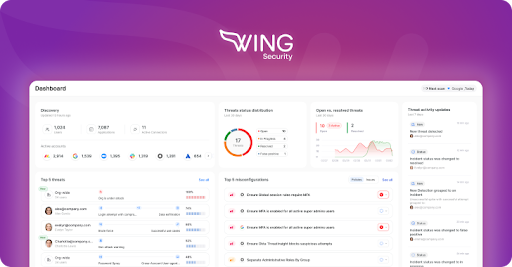
Wing Security is built for the agent layer. It helps security teams discover organizational AI agents, verify what they can access, trace what they actually do, and govern agent sprawl with context, prioritization, and next-step guidance.
Wing’s core premise is that intent is not execution: you need to compare what an agent was meant to do with what it can access and what it actually does.
This initiative matters because scaling AI agents introduces more than another credential type. Agents act across workflows and can create attribution gaps when a low-privileged user triggers a high-privileged agent.
Wing closes that gap by connecting each agent to its owner, linked identities, permissions, actions, and risk, so security teams can see where access matches intent and where it needs review.
Main features:
- Discovers AI usage from tools to features to agents and compiles it into an operational AI inventory.
- Maps agent ownership, origin, and access permissions across agent factories, IdPs, SaaS, and cloud platforms.
- Monitors permissions, access, and cross-app actions for identities interacting with enterprise systems.
- Identifies risky agent behavior such as over-permissioned access, unexpected cross-app actions, and potential authorization gaps.
- Maps third-party platforms, applications, and integrations that each agent can access.
Pricing: By inquiry.
Best for: Governing organizational AI agents by connecting agent identity, ownership, access, actual actions, business context, and risk.
Category 2: Local Agents
2. Cyberhaven

Cyberhaven helps security teams monitor how sensitive data moves across endpoints, cloud apps, SaaS tools, on-prem systems, and AI workflows. It is relevant to non-human identity activity monitoring, where AI use or automation creates data exposure risk.
Key features:
- Traces how sensitive data moves across endpoints, cloud, SaaS, on-prem systems, and AI tools.
- Combines DSPM, DLP, insider risk, and AI security to protect data wherever it lives or moves.
- Uses Linea AI and data lineage signals from cloud applications, endpoints, and browsers to accelerate investigations into risky data movement.
Pricing: By inquiry.
Best for: Monitoring AI-related data exposure.
3. MCPTotal / Autonomous Security
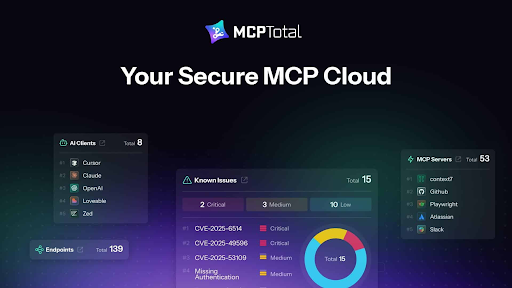
MCPTotal, which now markets its endpoint-agent security approach as the Autonomous Control Stack, focuses on local AI-agent and MCP security. It helps teams discover and control agentic activity on endpoints, especially where MCP servers, plugins, skills, and developer-side agents may introduce unmanaged execution or data access risk.
Key features:
- Controls AI agent behavior in real time across endpoints and IDEs.
- Intercepts and filters MCP traffic to reduce the risk of prompt injection and unsafe tool use.
- Moves MCP servers and credentials out of unmanaged local environments into isolated cloud environments, with token vaulting and sandboxing.
Pricing: By inquiry.
Best for: Securing local MCP workflows.
4. Operant AI Endpoint Protector

Operant AI Endpoint Protector monitors agentic activity at the endpoint. It focuses on local AI agent infrastructure, such as AI IDEs, coding agents, MCP clients, plugins, tools, and local AI workflows where sensitive data, prompts, credentials, or tool calls may leave the device.
Key features:
- Inspects AI IDEs, coding agents, desktop clients, MCP clients, skills, tools, and plugins directly on employee devices.
- Monitors prompt integrity, tool authorization, data classification, MCP inspection, and agent intent signals before activity leaves the endpoint.
- Watches tools such as Cursor, Copilot, Claude Code, and Codex for file access, shell access, plugins, prompt injection, secret leaks, and rogue tool calls.
Pricing: By inquiry.
Best for: Controlling endpoint AI agent activity.
Category 3: API Keys / Secrets
5. Akeyless
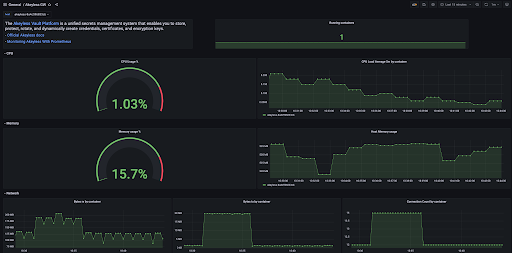
Akeyless helps teams reduce static credential risk by federating non-human identities and supporting secretless authentication patterns. It is most relevant where the NHI activity problem involves workload authentication, API access, machine credentials, and credential sprawl.
Key features:
- Authenticates machine identities across cloud, on-prem, and containerized environments without relying on static secrets.
- Uses AWS IAM, Microsoft Entra ID, and GCP Workload Identity Federation to authenticate workloads based on their native cloud identities.
- Supports ephemeral, just-in-time tokens issued through federated authentication instead of stored static secrets
Pricing: Free trial available; enterprise pricing is by inquiry.
Best for: Replacing static machine credentials.
6. GitGuardian
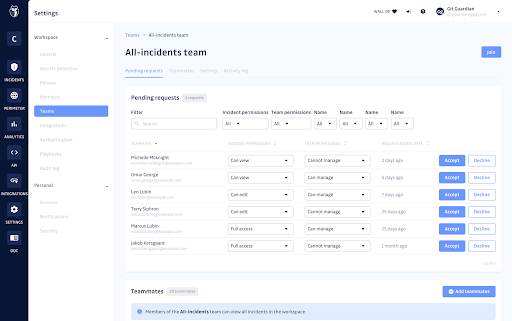
GitGuardian helps security and development teams detect, investigate, and remediate exposed secrets. It is relevant to non-human identity activity monitoring because API keys, tokens, and other machine credentials often serve as the access layer for automated workflows and agent-linked activity.
Key features:
- Scans internal codebases and developer workflows to find, fix, and prevent hardcoded secrets.
- Monitors public GitHub exposure to protect against leaked API keys, tokens, and other credentials.
- Combines secrets detection, public exposure monitoring, and non-human identity governance with automated remediation workflows.
Pricing: Free trial is available, plus paid plans.
Best for: Detecting exposed secrets in developer workflows.
7. Entro Security
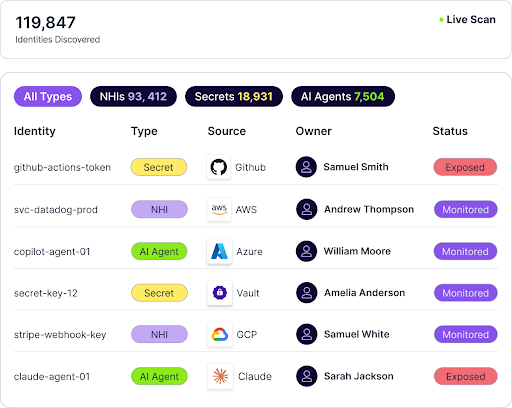
Entro Security helps teams discover, monitor, and govern AI agents, non-human identities, and secrets. It is relevant where security teams need to connect secret ownership, machine identity activity, access posture, and lifecycle risk.
Key features:
- Continuously monitors AI agents and non-human identities for behavioral anomalies across the stack.
- Tracks secret activity and flags idle or orphaned secrets for rotation before they become hidden exposure.
- Maps every NHI and secret back to a human owner so security, DevOps, and engineering teams can remediate faster.
Pricing: By inquiry.
Best for: Monitoring agent, secret, and NHI risk.
8. Astrix Security
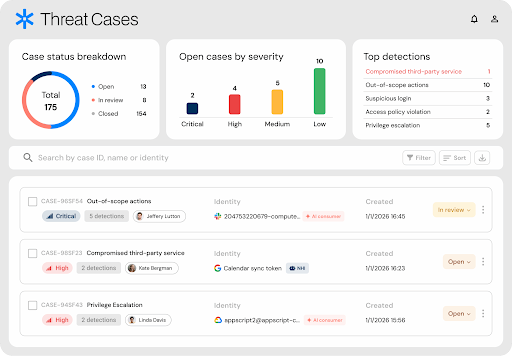
Astrix Security focuses on identity security for AI agents and non-human identities. It helps teams discover agents, MCP servers, OAuth apps, integrations, and other machine identities, then assess their privileges, configurations, activity, and policy posture.
Key features:
- Creates a single inventory of AI agents, MCP servers, and NHIs with business usage and risk context.
- Finds custom, third-party, homegrown, shadow, and unregistered agents.
- Supports least-privileged access policies, short-lived credentials, just-in-time access, scoped permissions, and audit trails.
Pricing: By inquiry.
Best for: Securing agentic AI and shadow NHIs.
9. Clutch Security
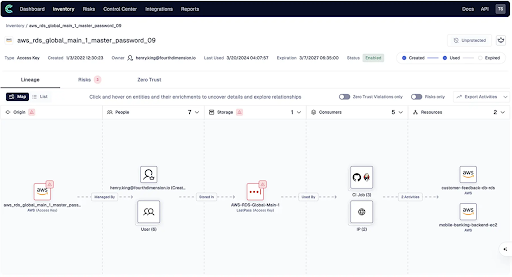
Clutch Security secures non-human identities, AI agents, and secrets using identity lineage. It helps teams understand where identities originate, who owns them, where secrets are stored, what consumes them, and which resources they can reach.
Key features:
- Connects every identity, agent, and secret to their origins, owners, storage locations, consumers, and reachable resources.
- Shows how people, agents, applications, secrets, and resources relate across the environment.
- Handles remediation, rotation, certification, and policy enforcement from detection through resolution.
Pricing: By inquiry.
Best for: Mapping NHI identity lineage.
10. Token Security

Token Security focuses on AI agent and non-human identity security. It helps teams discover AI agents and MCP servers, assign ownership, monitor activity, and govern access across multi-agent AI environments.
Key features:
- Correlates AI agents, humans, secrets, permissions, and data to reveal blast radius and remediation paths.
- Enforces ownership, intent, access, and governance from agent creation through retirement.
- Lets teams query Token Security from tools such as Claude, ChatGPT, Gemini, Cursor, and AI-agent applications.
Pricing: By inquiry.
Best for: Governing AI agent identity lifecycles.
Category 4: Service Accounts
11. Aembit
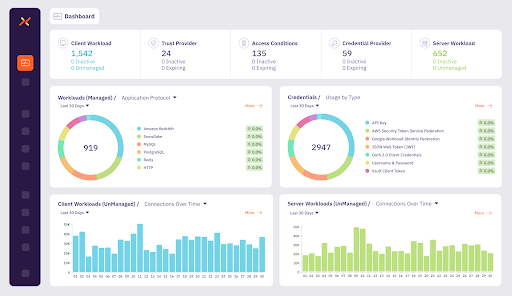
Aembit provides workload identity and access management for software workloads, services, and AI agents. It is relevant where teams need policy-based, secretless access from non-human identities to cloud services, SaaS apps, APIs, and internal systems.
Key features:
- Controls access for AI agents, MCP servers, and workloads across clouds, SaaS apps, and on-prem data centers.
- Combines agent and user context into a blended identity with real-time policy enforcement, token exchange, and credential isolation.
- Delivers secrets just in time, per task, without letting agents or workloads store or share long-lived credentials.
Pricing: By inquiry.
Best for: Enforcing secretless workload access.
12. Silverfort
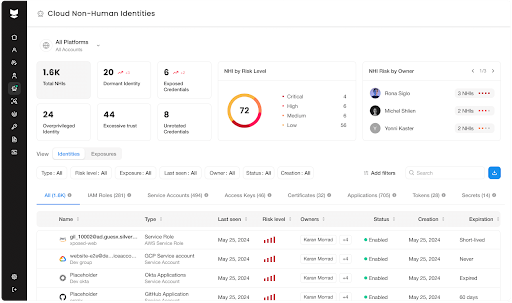
Silverfort helps teams protect service accounts, machine identities, automation scripts, cloud workloads, tokens, and keys. It focuses on discovering non-human identities, understanding their behavior, and enforcing access controls without disrupting legitimate automation.
Key features:
- Continuously discovers and maps AD service accounts and cloud NHIs using real access telemetry.
- Learns each service account’s usual access paths, privileges, activity frequency, source hosts, and destination systems.
- Enforces adaptive, real-time policies that block abnormal service account behavior such as unexpected destinations, privilege elevation, or lateral movement attempts.
Pricing: By inquiry.
Best for: Protecting service account activity.
13. Apono
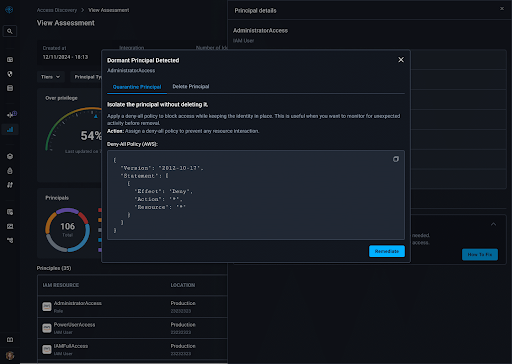
Apono focuses on reducing standing privilege for humans, machines, and AI agents. It addresses part of the agentic identity crisis by dynamically granting privileged access, scoping it to the task, and revoking it when no longer needed.
Key features:
- Creates access dynamically at runtime, scoped to the exact need, enforced in context, and automatically revoked.
- Applies just-in-time privilege controls to non-human identities and AI agents.
- Validates what an agent declares it will do against what it actually does in real time, then revokes access if the agent moves outside defined boundaries.
Pricing: By inquiry.
Best for: Reducing standing privileged access.
14. ConductorOne / C1

ConductorOne, now C1, provides identity governance for human and non-human identities, including AI agents, service accounts, API keys, secrets, and other NHIs. It helps teams bring machine identities into ownership, access review, lifecycle, and governance workflows.
Key features:
- Ingests, categorizes, and inventories service accounts, keys, tokens, and other NHIs from cloud and on-prem apps.
- Maps NHI relationships and applies controls for managing lifecycle and access.
- Supports remediation and access operations across web app, Slack, Microsoft Teams, and CLI.
Pricing: By inquiry.
Best for: Governing NHI access reviews.
15. Valence Security
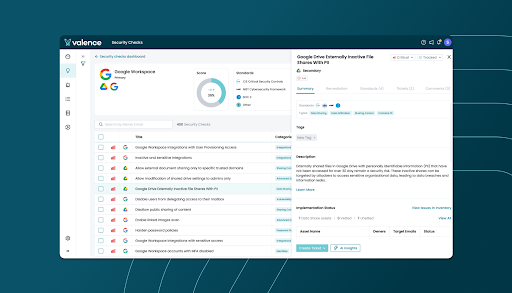
Valence Security focuses on SaaS-to-SaaS integrations and non-human identities in SaaS environments. It helps teams discover and govern OAuth tokens, API keys, service accounts, AI-driven connections, and third-party integrations that may hold excessive or unapproved access.
Key features:
- Monitors and governs external SaaS integrations to prevent excessive or unapproved permissions.
- Provides visibility into AI-driven SaaS connections and helps ensure they access only what they need.
- Finds and removes dormant or unused API keys and OAuth tokens that create hidden SaaS risk.
Pricing: By inquiry.
Best for: Governing SaaS integration risk.
How We Compared These Tools
We compared these tools using the same criteria so security and identity teams can shortlist the best fit. The evaluation is based on publicly available information as of May 2026, including vendor documentation and product pages.
Because non-human identity activity spans different systems and risk models, we grouped the tools into four categories:
Organizational agents:
These tools focus on AI agents operating across business workflows, SaaS apps, identity systems, and cloud environments. They help teams connect agent identity, access, actions, ownership, and risk.
Local agents:
These tools monitor AI agents, MCP clients, coding assistants, plugins, and tools running on employee endpoints or developer environments. They help teams control risky local behavior before sensitive data or credentials leave the device.
API keys / secrets:
These tools focus on API keys, tokens, hardcoded credentials, secrets, certificates, and other machine credentials. They help teams reduce credential-based exposure across development, cloud, SaaS, and automation workflows.
Service accounts:
These tools focus on service accounts, workload identities, automation scripts, machine identities, and privileged non-human access. They help teams baseline behavior, enforce least privilege, reduce standing access, and detect abnormal activity.
We reviewed:
- NHI and agent types covered
- Activity monitored
- Access intelligence and permission analysis
- Agent-specific fit
- Ownership, attribution, and business context
- Governance and remediation support
- Pricing visibility
We did not run hands-on tests for every tool. When a capability was not clearly documented, we avoided strong claims.
Bring AI Agents Under Control Before They Become Exposure
Monitoring non-human identity activity now means more than tracking service accounts, API keys, secrets, and workload identities. AI agents create a different control problem because they can hold access, trigger workflows, act across business systems, and make attribution harder.
The right tool depends on the identity type and use case. Some teams need secrets detection, service account protection or endpoint-level agent monitoring. But when AI agents operate across business workflows, security teams need to know which agents exist, what they can access, what they actually do, who owns them, and whether their access matches their intended purpose.
Wing Security is the control layer for organizational AI agents, helping you discover agents, map linked identities and permissions, compare intended access against actual access, trace actions, and prioritize agent risk. With Wing, your security and identity teams have the context to govern agent sprawl before it becomes exposure.
Request a demo to discover unknown agents, verify access, trace actions, and bring AI agents under control.