
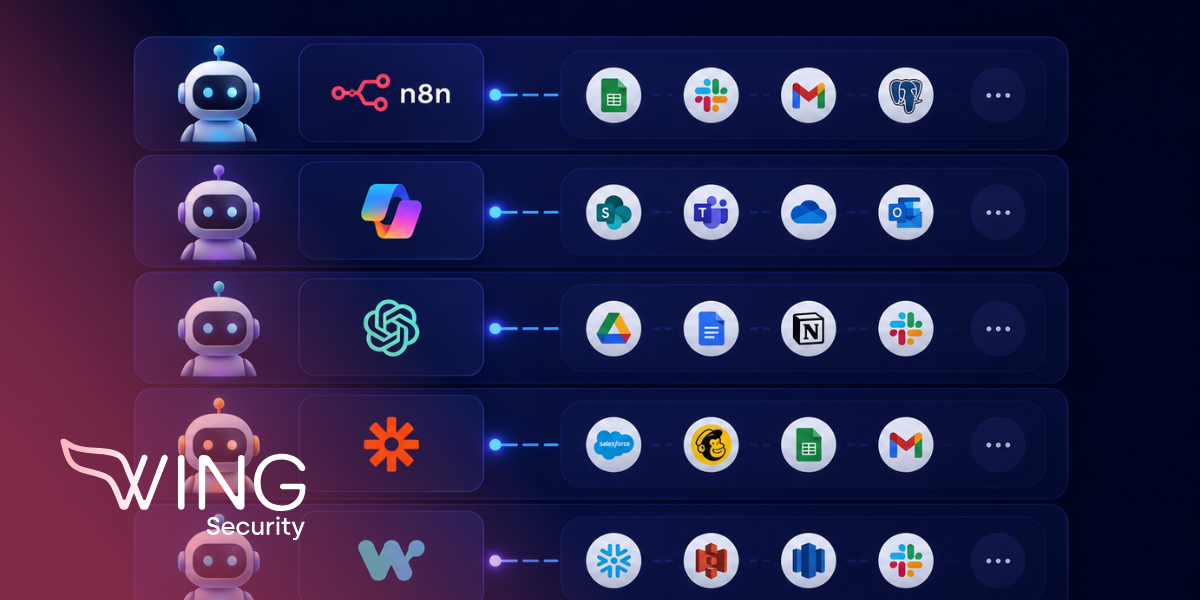
Artificial intelligence is no longer limited to chatbots and productivity assistants. Across organizations, employees are building, deploying, and sharing AI agents that can access business data, make decisions, trigger workflows, and act on behalf of users.
What started as experimentation has quickly evolved into a new operational layer inside the enterprise.
Today, employees can create AI agents with just a few clicks using platforms like Microsoft Copilot Studio, OpenAI GPTs, Google Gems, Salesforce Agentforce, ServiceNow AI Agents, and no-code automation platforms such as n8n, Zapier, Make, and Workato. Many of these agents are not personal tools. They are shared across teams, departments, and sometimes entire organizations.
As AI adoption accelerates, organizations face a critical challenge: they have no reliable way to answer a simple question:
What AI agents are operating in our environment today?
Without that visibility, security, compliance, and governance efforts are built on guesswork.
This is why maintaining an AI agent inventory has become one of the most important requirements for modern enterprises.
Is all Automated AI Considered an AI Agent?
An AI agent is an AI-powered system that can perform tasks autonomously or semi-autonomously by interacting with applications, data, and users.
Unlike traditional AI assistants that simply generate responses, agents can take action. They can:
- Access enterprise applications
- Retrieve and process sensitive information
- Trigger workflows
- Make decisions based on context
- Interact with other systems
- Execute tasks without direct human involvement
For example, an AI agent might:
- Generate customer proposals using CRM data
- Analyze support tickets and automatically escalate issues
- Create reports from multiple SaaS applications
- Provision accounts or update permissions
- Research competitors and share findings with teams
The key distinction is that agents don’t just answer questions. They act.
The Rise of Shared and Organizational Agents
The biggest governance challenge isn’t personal AI usage.
It’s the growing number of shared agents that operate across teams and business functions.
Modern AI platforms make it incredibly easy for employees to create agents that others can use.
Some of the most common agent factories appearing in enterprises today include:
Microsoft Copilot Studio
Organizations use Copilot Studio to build custom agents connected to Microsoft 365, SharePoint, Teams, Dynamics, and external systems. These agents are often shared broadly across departments.
OpenAI GPTs
Custom GPTs allow employees to combine instructions, knowledge sources, and actions into reusable AI agents. Many organizations now have hundreds or thousands of GPTs created by employees.
Salesforce Agentforce
Agentforce enables organizations to deploy AI agents for sales, customer service, and business operations, often with direct access to customer and revenue data.
Google Gems and Vertex AI Agents
Organizations can build specialized agents connected to Google Workspace and enterprise data repositories.
ServiceNow AI Agents
ServiceNow increasingly enables autonomous agents that can perform IT, HR, and operational tasks across business systems.
n8n
n8n has become one of the fastest-growing agent platforms because it combines workflow automation with AI capabilities. Employees can create agents that connect dozens of SaaS applications and trigger actions automatically.
Zapier, Make, and Workato
These platforms allow employees to create AI-powered workflows that can access sensitive systems and data without traditional software development.
The result is a rapidly expanding ecosystem of agents that often operates outside traditional security review processes.
Why AI Agents Create New Security Risks
Many organizations already inventory SaaS applications, cloud resources, and user identities.
AI agents introduce an entirely new asset category that carries unique risks.
Agents Often Have Extensive Access
An agent’s capabilities are determined by the applications and data it can access.
A sales assistant agent may connect to:
- Salesforce
- Google Drive
- Microsoft 365
- Slack
- Customer support systems
A single compromised or misconfigured agent can expose information from multiple business-critical systems.
Agents Can Act Without Human Approval
Unlike traditional applications, agents may take action automatically.
They can:
- Send messages
- Update records
- Share files
- Trigger workflows
- Execute business processes
This dramatically increases the potential impact of mistakes, abuse, or compromise.
Shared Agents Create Visibility Gaps
When employees create agents independently, security teams often have no record that those agents exist.
In many organizations:
- Nobody knows how many agents have been created
- Nobody knows who owns them
- Nobody knows what data they can access
- Nobody knows who can use them
This creates significant governance blind spots.
Sensitive Data Can Be Exposed
Many agents are connected directly to internal knowledge bases, file repositories, databases, and SaaS platforms.
Without proper oversight, agents may gain access to:
- Customer information
- Financial records
- Intellectual property
- Employee data
- Source code
- Strategic documents
The risk becomes even greater when agents are shared publicly or externally.
Orphaned Agents Continue Operating
Just as organizations struggle with orphaned SaaS accounts, they now face orphaned AI agents.
Employees leave. Projects end. Teams reorganize.
But agents often remain active with their existing permissions and integrations. Without inventory and ownership tracking, these agents can become unmanaged security risks.
Why an AI Agent Inventory Is Essential
You cannot govern what you cannot see.
An AI agent inventory provides the foundation for every other AI security and governance initiative.
A comprehensive inventory helps organizations answer critical questions:
- How many AI agents exist?
- Who created them?
- Who owns them today?
- Which agents are shared?
- Which business units use them?
- What systems can they access?
- What data can they retrieve?
- What actions can they perform?
- Are they still actively used?
- Do they comply with company policies?
Without these answers, organizations cannot effectively assess risk or enforce governance standards.
What Should an AI Agent Inventory Include?
Many organizations assume that simply listing agent names is enough. It isn’t.
A useful inventory should provide both discovery and context. At a minimum, organizations should track:
Agent Identification
- Agent name
- Platform or source
- Creation date
- Agent type
Ownership Information
- Creator
- Current owner
- Department
- Business purpose
Usage Information
- Number of users
- Shared versus personal status
- Activity levels
- Last usage date
Access and Permissions
- Connected applications
- Granted permissions
- Data sources
- Available actions
Security Context
- Sensitive data exposure
- External sharing status
- Policy violations
- Risk indicators
Lifecycle Information
- Active status
- Review dates
- Ownership changes
- Decommissioning status
This level of visibility transforms an inventory from a simple list into a governance tool.
What Wing’s AI Agent Inventory Provides
Wing’s AI Agent Inventory is designed to help organizations discover, understand, and govern AI agents across the enterprise.
Rather than relying on manual reporting, Wing automatically identifies agents created across supported AI platforms and provides rich context about each one.
Organizations can gain visibility into:
- Agent creators and owners
- Agent platforms and sources
- Shared versus personal agents
- Connected SaaS applications
- Access permissions
- Data exposure risks
- Usage patterns
- Security posture
Wing also helps security teams understand how agents fit into the broader SaaS ecosystem by correlating agent activity with application access, identities, and organizational policies.
This allows teams to move beyond simple discovery and toward meaningful governance.
Instead of asking whether AI agents exist, security teams can understand which agents matter, what risks they introduce, and how to manage them effectively.
AI Governance Starts with Visibility
The enterprise AI landscape is expanding faster than most organizations can track.
Every day, employees create new agents, connect new data sources, and automate new workflows. Many of these agents provide tremendous business value. Some introduce significant risk.
The challenge is not stopping AI adoption. The challenge is governing it responsibly.
An AI agent inventory provides the visibility organizations need to understand their AI footprint, reduce risk, and build a sustainable governance program.
As AI agents become increasingly embedded in business operations, maintaining an accurate inventory is essential for security.