
Chances are, your organization has AI agents running right now with access levels that your security team didn’t approve. In fact, even the agent’s user didn’t approve them.
Today, 79% of senior executives report AI adoption, yet 92% are concerned about the security implications. Gartner expects 40% of enterprise applications will embed task-specific agents (up from fewer than 5% in 2025). Security teams simply cannot keep up.
AI agents require a new control layer because they operate through identities, credentials, integrations, and workflows. Unlike chatbots, agents authenticate and execute workflows. When things break, you need answers: which agent acted, under whose authorization, using what credentials, touching what data?
What is AI agent security?
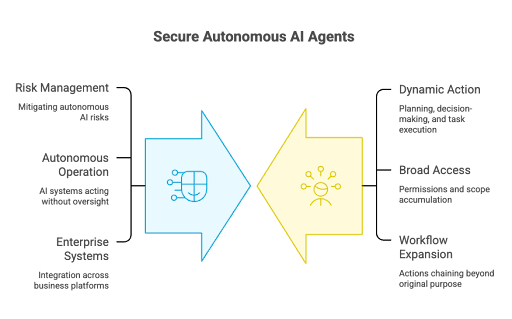
AI agent security is the discipline of managing and mitigating the risks introduced when AI systems operate autonomously (including planning, making decisions, and executing tasks) across enterprise systems without continuous human oversight.
The distinction from conventional AI security matters. Where chatbots respond, agents execute. An agent can authenticate, call APIs, access sensitive data, and chain actions across systems, so a small scoping mistake becomes an operational control problem.
When an agent is deployed for a narrow task (like validating vendor invoices), its intended scope is clear. But because it operates across integrations, its effective access rarely stays narrow. Permissions accumulate. OAuth tokens carry broader scopes than expected. Workflows expand. The agent’s actual capabilities can drift well past its original purpose, often without anyone noticing.
Why AI Agent Security is an Identity and Access Problem
When an AI agent operates inside an enterprise environment, it behaves like a synthetic user. It authenticates, requests access, and executes commands across systems. For teams already focused on monitoring non human identities, AI agents introduce a more dynamic control challenge.
They are not just credentials or service accounts to inventory; they are business actors that use identities, trigger workflows, access data, and take actions across connected systems.
As an agent’s workflows expand and integrations multiply, its effective access outgrows its authorized baseline unrecorded. A finance agent provisioned with read-only access to billing folders may, through a chain of OAuth tokens and SaaS API defaults, accumulate write access to systems it was never meant to touch. Nobody approved that expansion, and no one is watching it happen.
Delegated access creates another distinct problem. When an agent executes commands through its own broad service credentials (rather than inheriting the initiating user’s permissions), it creates a confused deputy vulnerability. A low-privileged employee can trigger an agent that operates with far greater access than they’d ever be granted directly. And downstream systems have no way to detect the discrepancy.
This is why action traceability is a prerequisite for any type of AI agent security strategy. The goal: answering four questions for any agent-triggered event. Without those answers, compliance reviews become guesswork, and incident response is blind.
- Who initiated the request?
- Which identity did the agent use?
- What workflow was executed?
- Which system or data was affected?
|
Control area |
Model-layer AI security |
AI agent security (agentic workflows) |
|
Asset discovery |
Find AI apps and models |
Inventory agents + agent-linked identities + where they execute |
|
Identity model |
User sessions, app auth |
Non-human identities (service accounts/OAuth tokens) acting as synthetic users |
|
Access control |
Prompt policies, data filters |
Least privilege at tool/API/SaaS layer + constrain delegated access |
|
Execution risk |
Bad answers, data leakage in outputs |
Autonomous actions: record edits, provisioning, approvals, deletes, exfiltration |
|
Traceability |
Log prompts and responses |
Full provenance: initiator → agent → credential used → actions → systems touched |
|
Drift |
Model behavior shifts |
Permission drift + behavior drift across integrations and toolchains |
|
Governance |
Policy + review cycles |
Continuous validation: intended access vs actual access |
|
Incident response |
Investigate outputs |
Investigate actions: “which agent did what, under which auth, to which system?” |
10 AI Agent Security Best Practices for Identity, Access, and Action Control
1. Discover and Inventory Every AI Agent and Linked Identity
Agents get spun up by individual teams, embedded inside SaaS tools, and wired into production workflows without ever touching a formal security review process.
The starting point for mitigating AI agent risks is implementing continuous scanning for autonomous workflows, third-party plugins, and multi-agent systems across your environment.
In addition, create and maintain a centralized agent registry that logs each active agent alongside its business purpose, human owner, defined scope, active permissions, and the non-human identity it operates through. Without a reliable inventory, no downstream governance is enforceable.
2. Assign Every Agent an Owner and Defined Purpose
As AI adoption expands across business units, ownership becomes the control point that keeps agents from becoming unmanaged shared infrastructure.
Every agent should have a named human accountable for it and a documented operational baseline to make governance enforceable. It also makes anomaly detection actionable: when an agent acts outside its documented purpose, there is a clear owner responsible for determining what happens next.
3. Compare Intended Access with Actual Access
Static permission tracking doesn’t capture what an agent can reach through delegated tokens, inherited OAuth scopes, or dynamically expanding API connections.
For example, consider an HR onboarding agent with a delegated OAuth token scoped to updating directory fields. If the agent already has broad OAuth scopes or access through an over-permissioned integration, prompt manipulation may cause it to retrieve or act on compensation data it was never intended to use.
Operational visibility (knowing roughly what’s running) is not the same as assurance-grade oversight, which requires confidence that all agents are identified, scoped, and subject to active control pathways. For governance, it’s insufficient. As such, Wing Security acts as the control layer for AI agents, helping teams compare intended access with actual access, trace agent activity, and prioritize risky gaps for review and remediation.
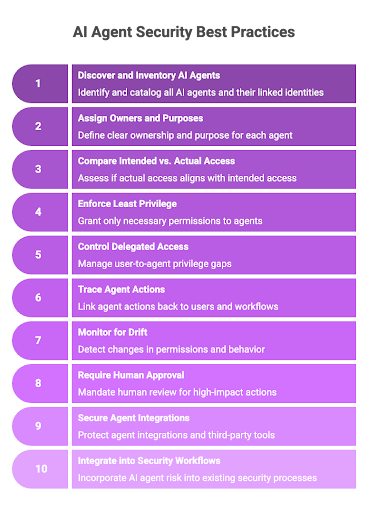
4. Enforce Least Privilege for Tools, APIs, and SaaS Permissions
Much like other NHIs, AI agent accounts should carry exactly the access they need to complete their defined task and nothing more. Unlike static machine identities, they also need purpose, invocation, workflow, and action context so teams can determine whether access still matches intended use.
OAuth defaults, MCP/server tool configurations, local credential exposure, and API defaults routinely expand agent access beyond what teams intended. A marketing agent connected via a CRM OAuth token to process incoming leads may inherit access to records well beyond its operational scope. If it hits an indirect prompt injection, excess permissions expand the blast radius from an unwanted response to unauthorized access or data exposure.
Enforce least privilege at the tool execution layer in addition to the identity layer. Scope SaaS permissions explicitly, audit MCP server connections, and validate that API integrations reflect the agent’s actual operational requirements and not platform defaults.
5. Control Delegated Access and User-to-Agent Privilege Gaps
When an agent uses broad machine-to-machine credentials, a low-privileged user can trigger actions through it that they’d never be permitted to execute directly.
For instance, an IT troubleshooting agent operating with a high-privilege M2M token should, at a minimum, have its execution dynamically constrained by the permissions of the person who triggered it. When it isn’t, the privilege gap creates a vector for both external manipulation and internal misuse.
Validate the initiating user’s identity and scope downstream to close this gap, ensuring authorization decisions reflect the human operator’s actual permissions.
6. Trace Agent Actions Back to the Originating User, Identity, and Workflow
Without end-to-end provenance, audit gaps compound quickly. Make sure that every downstream action is traceable to its source: who initiated the workflow, through which identity, as part of which task, affecting which system.
A cloud operations agent using an administrative service account may provision resources, modify configurations, or write to production databases using its own non-human credential, with no visible link to the human request that started the chain. If that session is hijacked, the damage unfolds without a clear audit trail.
7. Monitor for Permission Drift and Behavior Drift
Agents are inherently active entities. As integrations expand and engineers connect new tools to existing deployments, both permissions and behavior shift. This is especially important as multi agent AI moves from isolated experiments into connected business workflows.
Consider a customer support agent scoped to public-facing documentation that may gain access to internal source repositories as backend tools are added to its profile over time. In agentic systems, a successful attack doesn’t just produce an unwanted response. It can redirect a drifted agent into exfiltrating data from internal systems or generating unauthorized code modifications.
To address this, you need continuous access and activity context across both dimensions: permission changes and activity that diverges from the agent’s documented purpose. Baselining expected agent behavior and clustering trace variations helps detect when execution patterns diverge from the authorized baseline.
8. Require Human Approval for High-Impact Actions
Autonomous execution without validation is an acceptable risk for low-stakes, reversible tasks. Not so much for actions that are irreversible or carry significant downstream consequences.
For instance, an inventory procurement agent authorized to draft purchase orders represents a different risk profile than one with direct access to execute financial transactions or delete database records. That line can blur in multi-step workflows, especially if prompt injection poisons reasoning mid-task, leading it to autonomously authorize unintended bulk transactions or data deletions.
Programmatic approval gates that halt execution before irreversible actions and require explicit human sign-off bound the risk without eliminating automation.
9. Secure Agent Integrations, Memory, and Third-Party Tools
The AI agent itself is just one part of the attack surface. The plugins it connects to, the MCP servers it routes through, and the external data it ingests are all potential entry points.
EchoLeak (CVE-2025-32711) showed how a zero-click prompt injection in Microsoft 365 Copilot could enable data exfiltration. It serves as a clear illustration of what happens when the agentic supply chain is treated as trusted by default.
Make sure to vet every plugin and MCP server with the same rigor applied to any third-party software dependency. Continuous identity validation across external integrations and strict control-plane filtering of which external data agents can act on are critical components of an AI agent security strategy.
10. Bring AI Agent Risk into Existing Security, Identity, and Governance Workflows
Securing AI agents doesn’t require rebuilding your entire information security infrastructure. You just need to extend it to cover the agent layer that traditional tools were never designed to see.
Feed agent discovery data into your SIEM, ensure that agent identity drift triggers alerts in your IGA platform and behavioral anomalies surface in your MDR workflow. So when a reviewer or auditor asks whether AI agents are operating within authorized boundaries, the answer needs to come from live telemetry (backed with policy documentation that was written before the agents were deployed).
Wing Security operationalizes this integration, completing the security infrastructure rather than replacing it. Wing brings agent discovery, access intelligence, action context, and risk prioritization into existing security, identity, and governance workflows without replacing the IdP, SIEM, MDR, or IGA stack.
Shifting AI Agent Security from Policy Checkboxes to Operational Control
AI agents are active business actors with identities, permissions, SaaS integrations, and the ability to execute consequential actions across enterprise infrastructure. All without a human present. The risks that make AI agents different from other NHIs are specific: unknown agents accumulating access, unclear ownership, delegated privilege gaps, permission drift, and untraceable actions. The core challenge cuts across all of them: intent is not execution, and security teams cannot govern what they cannot see at runtime.
Wing Security provides the operational control plane to close that gap by delivering real-time agent discovery and live inventory, continuous comparison of intended versus actual access, and granular action tracing back to the originating user, identity, and workflow. If your agents are already in production, now is the time to find out what they can actually do.
Request a demo to discover unknown agents, verify access, trace actions, and govern agent sprawl before it becomes exposure.