
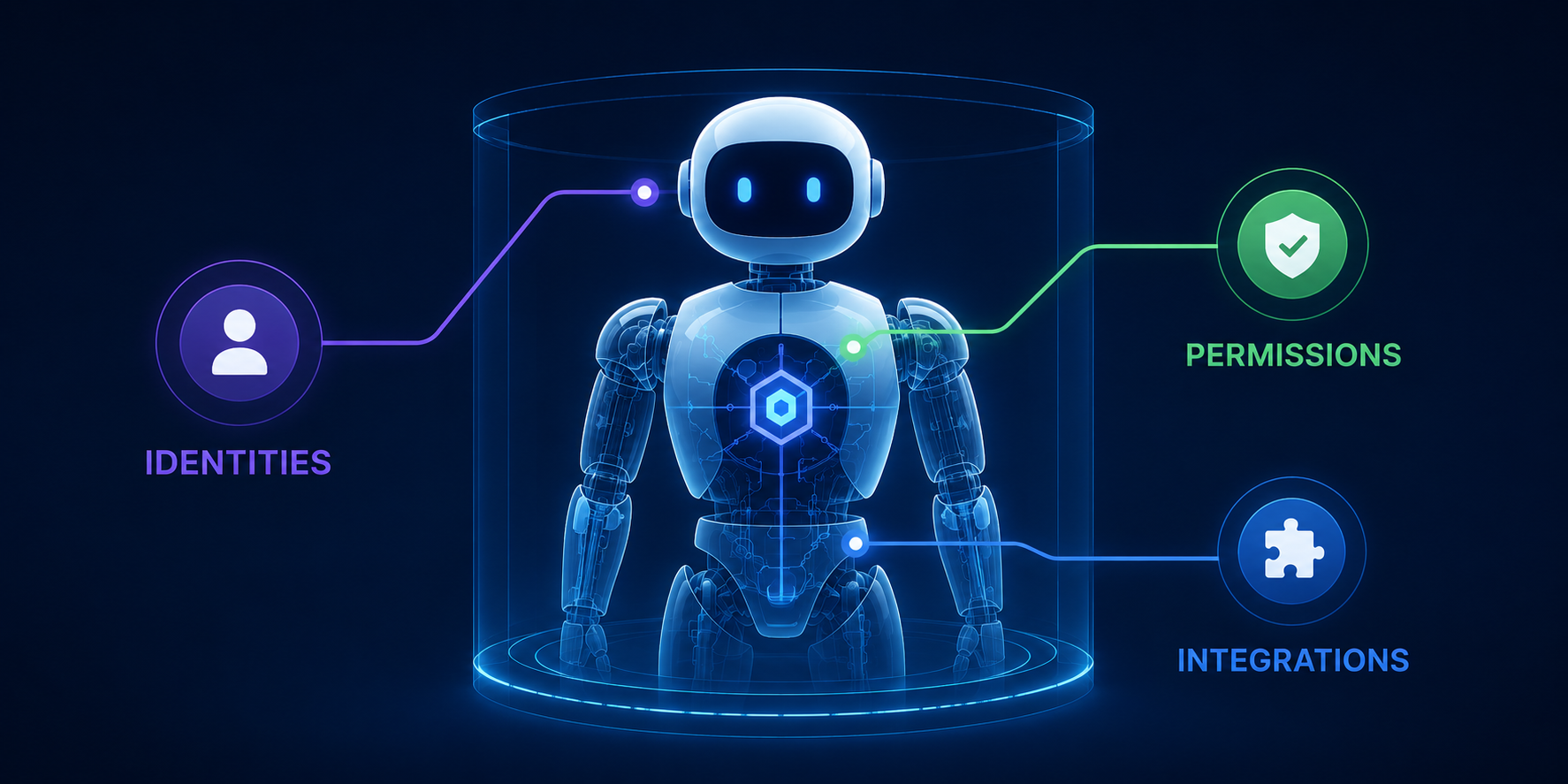
Abstract: Agentic AI governance gives InfoSec teams a way to discover which agents exist, who owns them, what identities and permissions they rely on, what actions they take, and whether their behavior still matches their intended purpose.
This guide explains how security teams can:
- Discover which AI agents exist across the environment
- Identify who owns each agent
- Understand the identities, permissions, and integrations each agent relies on
- Trace what actions agents take across connected systems
- Determine whether agent behavior still matches its intended purpose
- Bring AI agents under control through discovery, access intelligence, action tracing, risk prioritization, and operational remediation workflows
You likely spend weeks vetting new SaaS vendors, OAuth apps, and third-party integrations. Yet AI agents are being connected to sensitive SaaS systems, data stores, and workflows before security teams have a complete view of their identities, permissions, owners, and actions. That gap is becoming harder to ignore. Deloitte found that only 21% of surveyed organizations have mature governance frameworks for agentic AI, even though 74% expect moderate or heavy agent deployment by 2027.
Agentic AI governance gives InfoSec teams a way to discover which agents exist, who owns them, what they can access, what they actually do, and whether that activity still aligns with their intended purpose.
What is agentic AI governance?
Agentic AI governance is the discipline of discovering, controlling, and reviewing autonomous AI agents that use integrations, identities, and permissions to act across systems.
Classic AI governance focuses on responsible use, compliance, and model-level risk. AI risk management for agents needs to go further because agents can access systems, trigger workflows, and take actions across connected systems.
Once an agent starts executing tasks, it may operate through a service identity, a workload identity, an OAuth app, an API token, or delegated user access. Prompt filters alone will not show which systems it can access, what actions it takes, or whether that activity matches its intended purpose.
Model-layer AI security can help with prompts, guardrails, and model misuse. Traditional IGA and access tools can help with entitlements and approvals. But agentic governance requires a control layer that connects the agent, owner, identity, access, integrations, actions, and business risk.
To manage this, you need to map these exact technical boundaries:
- Agent Inventory: A live inventory of every AI agent, agent-linked identity, and connected workflow operating across cloud apps, agent factories, and identity environments, especially the ones spinning up under the radar.
- Ownership Context: Every piece of automation has to tie back to a real person on your team, so you know exactly who to contact if an agent behaves unexpectedly.
- Identity and Access Mapping: Teams need to map each AI agent to the credentials, service accounts, system tokens, delegated permissions, and agent-linked identities it uses to access connected systems.
- Tool and SaaS Connections: Teams need an operational map of every third-party database, API endpoint, SaaS integration, and webhook connected to each agent.
- Intended Purpose vs. Actual Activity: A straightforward comparison engine that checks what a model was built to do against the actual data files and system paths it is touching.
- Action Attribution: Audit trails that help trace agent activity back to the originating user, identity, workflow, or trigger.
- Risk Prioritization: A risk prioritization model that surfaces exposure based on over-permissioned access, sensitive data reach, unclear ownership, or misaligned behavior, so you fix the highest-risk exposure first.
- Review and Remediation Workflows: Operational workflows to review risky agents, adjust access, assign ownership, and route remediation through existing security processes.

Why Agentic AI Governance Matters for InfoSec Now
AI agents are getting deployed across sales, finance, and engineering workflows. Teams may be able to create or connect agents through third-party apps before the security review is complete. This problem leaves us with shared agents that break standard user-based access models, meaning a low-privileged user can write a prompt that accidentally triggers high-privileged backend system actions.
For example, if someone connects an automated finance agent to a chat channel to process invoices and update records via an accounting API, the security question is not just whether the agent has been approved. It is whether the agent’s identity, access, actions, and originating user can be traced and reviewed. Gartner predicts that over 40% of agentic AI projects risk cancellation by the end of 2027 due to spiraling costs, unclear value, or inadequate risk controls.
Governance is not a blocker to adoption. It is what makes agent adoption sustainable, especially when teams apply security best practices that account for agent identity, access, ownership, and traceability of actions.
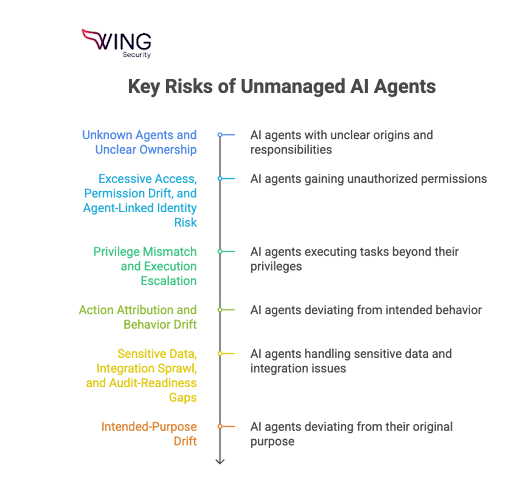
The Main Risks of Unmanaged AI Agents
Unknown Agents and Unclear Ownership
Organizations face significant blind spots when unvetted automation assets are deployed across the network. Teams cannot defend systems you cannot see. This problem leaves orphan processes running indefinitely, with no internal point of contact when anomalies arise, leaving you with no one to ping for immediate containment.
Excessive Access, Permission Drift, and Agent-Linked Identity Risk
Automated tokens rarely undergo standard privilege reviews. Most automated tokens are set-and-forget. As users tweak what an agent can do, its background credentials creep outward, accumulating broad access across systems. This permission drift leaves us with over-privileged service accounts sitting active on the network, essentially increasing the blast radius if the credentials are misused.
Privilege Mismatch and Execution Escalation
Security gaps arise when a workflow bridges low-security communication spaces and high-security data environments. The moment an agent bridges a low-security app like Slack with a high-security environment like a production database, you have a structural access risk. A low-privileged employee may be able to trigger actions through a higher-privileged agent if the workflow does not enforce the user’s own access context.
Action Attribution and Behavior Drift
Security logs may only show a valid token, app, service principal, or workload identity executing commands. This is why monitoring non-human identity activity needs to include the agent, linked identity, originating user, workflow, and action context. If an agent is manipulated into copying files or changing database schemas, the audit trail can appear to be routine system traffic.
Sensitive Data, Integration Sprawl, and Audit-Readiness Gaps
Untracked third-party connections break data isolation strategies. This sprawl creates gaps in audit trails, making it difficult to prove AI governance controls when a security review or compliance check lands on your desk.
Intended-Purpose Drift
A system designed to clean formatting within a database can slowly evolve into an asset that copies or reorganizes structural schemas. With traditional software, capabilities only change when someone merges code. With agents, operational scope can shift through prompts, added tools, expanded permissions, configuration changes, or new integrations. An AI agent approved only to reformat records could expand in practice to copying data, reorganizing schemas, or triggering workflows outside its intended purpose.
Operational Governance Best Practices
Effective AI agent security starts with active governance: a live list of agents, clear human owners, mapped identities and permissions, action traceability, and workflows for review or remediation.
1. Start With Agent Discovery, Not Policy
You need automated mechanisms to scan cloud environments, identity registries, agent factories, and connected apps for agents running in your infrastructure. At this stage, a dedicated platform like Wing Security serves as a discovery engine, helping uncover agent sprawl across cloud apps, agent factories, and identity environments, including agents no one is actively monitoring.
2. Assign Definite Ownership to Every Agent
Every autonomous asset you find should map directly to a specific user or account holder in your internal directory. If an agent starts drifting or hitting unapproved file shares, you need to know the responsible engineer or department head to handle triage and containment effectively.
3. Map Agents to Identities, Permissions, and Integrations
You cannot manage an agent’s security posture if you only treat it as a generic software tool. It is a dynamic identity with access, integrations, and operational context. In practice, this requires mapping out the exact tokens, service credentials, database connections, and third-party SaaS platforms the agent relies on. Wing helps connect these dots by mapping agents to the identities, accounts, permissions, integrations, and systems they rely on, so teams can understand the potential blast radius of risky access.
4. Compare Intended Access With Actual Access
It is important to audit what agents are doing versus what they are allowed to do. There is no reason a calendar utility should hold active write privileges for a financial ledger. When you find an automated process using a fraction of its network access, you need to scale back those keys right away.
5. Trace Agent Actions Back to the Originating Identity
It is not enough to know that an agent made a backend change. You need to know which user, identity, prompt, workflow, or trigger initiated the action. This oversight provides defensive teams with the clarity they need to reconstruct timelines, investigate incidents, and determine whether the action aligned with the agent’s approved purpose.
6. Prioritize Risk Based on Complete Business Context
If security tools dump hundreds of uncontextualized AI alerts into your queue every morning, alert fatigue will cause the team to miss what matters. Effective AI risk management requires ranking agent risk by data sensitivity, active credentials, ownership, permissions, and cross-app behavior at the same time. That allows teams to focus first on the agents that create the highest exposure, such as an unknown agent with broad access to sensitive systems.
7. Bring Agent Governance Into Existing Security Workflows
Agentic AI governance should not replace your existing IdP, SIEM, MDR, or IGA infrastructure. Instead, it should add the agent-specific context those systems need: ownership, access, action traceability, purpose alignment, and risk prioritization.
Wing fits this role by helping security and identity teams bring agent discovery, access intelligence, action tracing, risk prioritization, and remediation guidance into existing security and access-review workflows.
Bring AI Agents Under Control Before They Become Exposure
Regular corporate identity tools and model-layer guardrails protect only a small part of the network. They won’t tell you if a script is using valid tokens to pull data it shouldn’t be touching. You have to track the specific service accounts these models use and verify that their background activity aligns with the purpose for which you deployed them.
Wing Security helps teams move from AI policy to operational control. Wing provides AI agent discovery across cloud applications, agent factories, identity environments, and business workflows. It builds an agent-linked identity inventory that maps the accounts, permissions, systems, and third-party integrations each agent relies on.
Through an analysis of intended versus actual access, Wing helps teams compare what an agent was meant to do with what it can actually access. It also adds ownership context and risk prioritization, so your analysts can focus first on unknown, over-permissioned, or misaligned agents that require review or remediation.
Book a demo with Wing Security to discover unknown agents, verify access, trace actions, and govern agent sprawl before it becomes exposure.